
Custom AI Software Development for the Logistics Industry
Logistics has never been easy, and today’s operations across and around supply chains are more complicated than ever. Thankfully, technology goes hand in hand with customer expectations, economic changes and regulations. As of today, there is an entire smörgåsbord of AI solutions and tools that address different aspects of logistics. The question is, how do you match your choices to tangible results, both intermediate and long-term?
At Lionwood.software, we develop AI-powered software for various types of logistics businesses, covering transportation, inventory management, resource optimization, compliance, sustainability, and warehouse automation. Here, you can learn more about our approach and custom AI software development services.

WHAT LOGISTICS CHALLENGES CAN BE ADDRESSED WITH AI TOOLS?
Optimizing resource allocation
Since a typical logistics process will incorporate various types of resources – trucks, warehouse space, capital, labor – managing all of these holistically is an equation with multiple unknowns. Which is exactly the type you can delegate to AI. Separate aspects are already handled very efficiently: dynamic route optimization, warehouse automation, workforce scheduling, demand forecasting can now function in conjunction thanks to artificial intelligence and integrations.
Minimizing transportation and storage space costs
Artificial intelligence offers several ways to mitigate the effects of cost inflation across functions: smarter route management, load consolidation, and predictive planning. For example, in fleet optimization, delivery patterns can be analyzed to elicit suggestions, while load matching of the shipments to the right vehicle capacity allows to avoid trucks being underutilized for the same amount of fuel. What-if scenario analysis akin to digital twinning is also a workable method for many businesses.
Achieving supply chain visibility
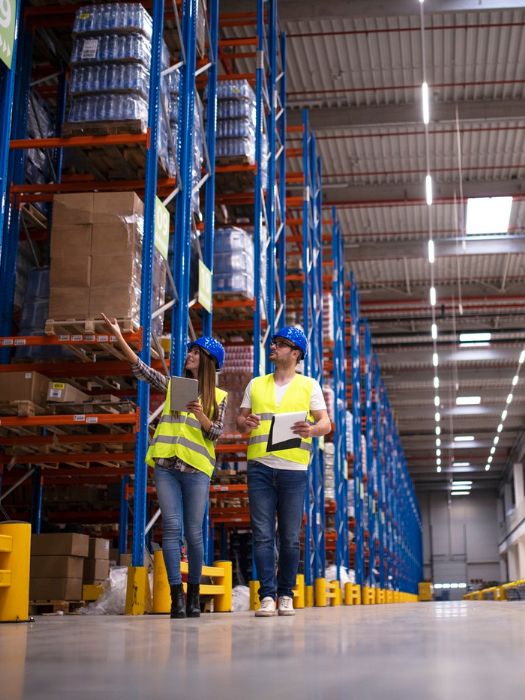
Supply chain visibility platforms have existed before ML but now their potential is enhanced thanks to the possibility of aggregating large amounts of real-time data from suppliers, transporters, and customs alike. AI can help identify potential disruptions and weak links, too, and even simulate alternative scenarios in case such disruptions do happen. Additionally, artificial intelligence helps make supplier risk scores more objective by taking more “variables” into account.
Ensuring business resilience
Artificial intelligence has the convenient trait of detecting trends faster than humans do, and this is best used for functions that increase business resilience and crisis management. Predictive analytics dashboards provide early warnings of demand shifts or operational risks, while algorithms can help with suggesting fallback options (routes, warehouses). Additionally, AI is good for keeping hand on the pulse of demand-supply balance, which can be used in inventory management.
Facilitating sustainability
AI-powered tools are also a good option for facilitating compliance with sustainability standards. Carbon footprint analytics, energy optimization, eco-route planning and other types of solutions are an elegant way to nip non-compliance risks in the bud.
AI Solutions for Logistics We Work On
Demand forecasting & inventory management tools
Using data from ERP, POS, and supplier databases, demand forecasting models can analyze history of sales for market trends, seasonal fluctuation, and the like to predict in what way inventory levels should be optimized – or redistributed between warehouses. Such solutions can then be integrated with WMS to enable auto-adjustment or automated replenishment.
Route optimization & last-mile delivery
Digital platforms for route adjustment can exist without AI, but with reinforcement learning, adaptive routing advances to a higher lever. Other technological methods at use here include GNNs and heuristics, like “ant colony” optimization. This allows to adjust delivery routes based on more factors, account for delivery windows and vehicle capacity more precisely, and thus not just reduce transit time and fuel costs, but also improve last-mile delivery tactics.
Warehouse operation enhancement (IoT + AI)
At a certain stage in scaling, previously insignificant warehousing inefficiencies start to need a solution – and that is where artificial intelligence and IoT become a go-to method. We develop tools that use computer vision models (e.g. for pallet recognition) with predictive analytics for batching and slotting to optimize storage under different conditions. Custom models can also be made to account for factors like temperature and humidity from sensors.
Predictive maintenance
We develop solutions that use sensor data and AI models to detect early signs of wear or malfunction in machinery (or vehicles), thus allowing to prevent unexpected downtimes. Using anomaly detection models and ML classification in conjunction with telematics, these predictive maintenance tools can then be embedded in fleet management software or integrated with other tools to auto-schedule maintenance calls.
Document processing & compliance automation
Since document processing and reporting is one of the operational areas that are most efficiently automated, natural language processing can further reduce the effort here. In combination with rule-based engines and LLMs, such tools can not just automate document handling but also help ensure compliance during data entry and validation.
Popular Features We Develop
-
Dynamic route optimization engines
Allow to continuously analyse live traffic, fuel prices, factors that influence delivery, etc. to adjust routes in real time.
-
Smart fleet scheduling & load balancing
Optimize the way vehicles are assigned and loaded to reduce empty or half-empty runs, using transport to full capacity.
-
Predictive maintenance modules
Artificial intelligence tools that use sensor and telemetry data like vibration, oil condition, etc. to predict when vehicles are likely to require intervention.
-
Automated warehouse management
AI-powered addition to WMS (or standalone integrated software) that uses computer vision and ML to control layout, allocate slots for storage, and help ensure robotics operation in picking.
-
Demand forecasting tools
Apply ML to data on sales to balance inventory levels with the demand, reducing overstocking or shortages (thus minimizing need for redistribution).
-
Workforce planning modules
Predict workload peaks and times when more resources are needed and come up with suggestions about optimizing shift schedules. Can also automate task assignments to drivers and warehouse staff.
-
Supply chain risk monitoring dashboards
AI-assisted data aggregation and visualization tools that help identify early warning signs of possible disruptions and suggest alternative options.
-
Autonomous delivery coordination
Integrates AI with autonomous vehicles or drones to handle last-mile delivery where conventional methods are not feasible.
-
ETA prediction and customer communication modules
Combine traffic data and IoT tracking to improve ETA accuracy, which can then be used in communication with customers (e.g. in chatbots or notifications) for better user experiences.
-
Fuel optimization engines
Analyze driving patterns and vehicle conditions, juxtaposing them to route data, and recommend efficient driving modes and refueling tactics.
-
Carbon footprint, ESG compliance trackers
Calculate CO₂ emissions across routes, warehouses, and operations, helping logistics firms meet sustainability targets and automate ESG reporting.
-
Contract and/or documentation automation
Software that uses NLP and OCR to process invoices, customs forms, etc. – now commonly used to cut administrative costs and double-secure compliance.
-
Adaptive pricing modules
Use predictive analytics to dynamically adjust shipping/storage rates based on custom selected criteria (demand, fuel prices, operational constraints).

Why Custom Logistics Software Development for Artificial Intelligence Implementation?
While there already are multiple specialized off-the-shelf AI solutions for the logistics industry, in many cases, custom development is required to preserve the unique know-hows or operational details of the company. We recommend going for custom AI development if your organization needs the software to reflect its particular mix of routes, assets, and service models.
Additionally, many businesses in logistics either need custom data pipelines reliant on legacy systems (ERP, WMS, etc.) – or work with unique, exclusive datasets that require special model training. Finally, if you want to use AI for helping with “cross-layer” decision making, i.e. juggle with factors from transport, warehousing, and other aspects holistically, custom AI tools are the best conceivable option.
Our Custom Logistics AI Development Services
- Project discovery & feasibility analysis
- Data integration
- Data governance
- AI consulting & solutions architecture
- Model training
- Computer vision & image processing
- Optimization and predictive analytics development
- AI system integration
- Dashboards and BI development
- Model deployment & DevOps
- Support & maintenance
- Staff onboarding
Benefits
When implemented properly, artificial intelligence can enhance almost every logistics process, so the benefits observed across different projects are also very different. The most commonly reported ones are:
- increased operational efficiency in the target function;
- reduced transportation costs (sometimes even if it’s a project that’s not directly concerning transportation as such);
- better overall resource allocation sensibility;
- improved, more methodical inventory management;
- improved business resilience and supply chain visibility;
- better overall CX; easier sustainability and ESG compliance.
Why Choose Us
Attention to the nature of target logistics services
We take care to apply AI capacities with precise fit to what the operational processes look like in your organization. When a particular workflow is cross-functional or has specific factors and constraints at play, this affects the solution design, model development, and approaches to data – so we always start with the understanding of the process and where it fits in the bigger picture.
Focus on scalability and adaptability
Our approach is that of creating solutions that will not only pass as successful PoCs, but lay the groundwork for further business growth. We incorporate scalability considerations at the foundational stages of product concept.

Careful integration with legacy platforms
Since many logistics businesses already have legacy digital software in place, which is typically quite diverse and implemented at different stages in the company’s evolution, we strive to create AI tools that will not disrupt the current equilibrium but rather enhance it – with custom integrations and data policies where necessary.
Impeccable user experiences
Any digital tool, AI included, is as good as the user adoption level it can reach. We always work to ensure that whoever is using the software will keep the comfortable level of control over the process and enjoy the convenience the solutions brings without compromising their professional methods of work.
AI Solution Development Process
 DISCOVERY
We collaborate with the customer to define the opportunities, feasibility, and overall architecture of the solution, producing a workable project roadmap.


 DATA PREPARATION
This stage involves data cleaning, normalization, labeling, and integration, so that we get an appropriate dataset for model implementation.
 MODEL DESIGN & TRAINING
At this point, we select, develop and train the model, engineering features, tuning hyperparameters, and testing the resulting functioning.
 PROTOTYPE
Here, you obtain a functioning PoC / MVP for validation under real-life conditions (live data streams), so that the resulting feedback and performance report can be used to fine-tune the model.
 DEPLOYMENT
We implement the full integration of the solution with the existing digital infrastructure (ERP, TMS, WMS or other systems as necessary) and deploy it in the cloud or on-premise as needed.
 MONITORING, OPTIMIZATION, MAINTENANCE
Apart from solution maintenance, we monitor the model for accuracy and compliance with regulations if necessary.
To find a perfect solution